Reviewing a PBM/Payer’s Prior Authorization Response
After a completed Question Set has been submitted, the PBM/payer will review the information submitted and return a response. This response can be reviewed in the Worklist detailed in the Worklist OverviewWorklist Overview section.
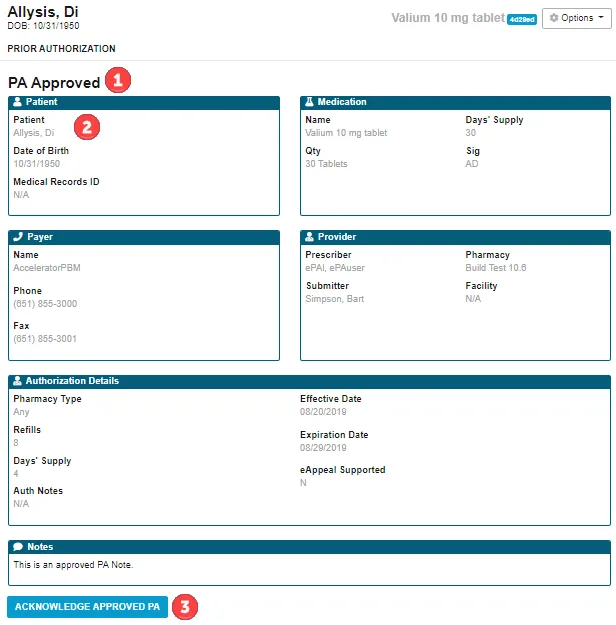
- Prior Authorization Response Type – The response from the PBM/Payer could be any of the NCPDP standard response types (Approved, Denied, Closed).
- Information/Details – Depending on the status of the response, boxes could contain information such as Authorization Details, Outcome Information, Patient Information, Notes, Attachments, etc.
- Action Buttons – The available actions for the selected task are displayed here. They are role- and task-specific (e.g., if eAppeal is supported, the Appeal button appears. If the user does not have appropriate access or eAppeal is not supported, the button is not present).
Acknowledge a Response
The user is required to acknowledge a response from a PBM/payer. Acknowledging a response eliminates any possibility for a user to appeal the response electronically, although manual appeal is still possible (using the PA Case ID). The user will receive one of the following NCPDP standard response types:
- Approved – Indicates that the PBM/payer approved the prior authorization.
Note: There are cases where the PBM/payer may have made changes regarding the prior authorization details (e.g. refills or days supply). Users should pay close attention to the Authorization Details information box and the PA Note as there may be additional information.
- Denied – Indicates that the PBM/payer denied the prior authorization for the requested patient and medication.
- Closed – Indicates that the PBM/payer closed the prior authorization process due to the reason specified in the Notes field.
Responses That Contain an Attachment
If the response from the PBM/payer contains an attachment, an Attachment section is displayed.
Click the Accept and Download button to view the .zip file containing the attachment. Ensure that proper security protocols are followed when viewing protected health information (PHI).